In this chapter
“The duty of the man who investigates the writings of scientists, if learning the truth is his goal, is to make himself an enemy of all that he reads, and ... attack it from every side.”
— Ibn al-Haytham, Doubts Concerning Ptolemy (c. 1025)
Philosophy is a long conversation. Most of the concepts in this guide were invented to answer a specific problem raised by a specific person. Knowing the history helps you remember the ideas, because you remember why each was needed. It also protects you against a common mistake: taking a position that was refuted three hundred years ago as fresh and obvious.
This chapter is a guided tour. It is not complete (no history of 2,500 years of thought can be), but it covers the figures and turning points you will meet again and again, and points you to the chapters where their ideas are developed.
Ancient Greece
The Presocratics and the Sophists
The earliest Greek philosophers (6th–5th centuries BCE) were mostly concerned with the nature of the cosmos, but they already raised the question of how humans could know it.
Xenophanes of Colophon (c. 570–475 BCE) may be the first fallibilist in the Western record:
“No man knows, or ever will know, the clear truth about the gods and all the things I speak of. For even if he should happen to say what is completely true, he himself does not know it; but opinion is allotted to all.” (Fragment B34)
And, more hopefully: “The gods did not reveal all things to mortals from the beginning, but by seeking, in time, they discover better” (B18). Karl Popper admired these fragments as an early statement of the idea that knowledge grows by conjecture and correction. Xenophanes also noticed that people imagine gods in their own image: “Ethiopians say their gods are snub-nosed and black; Thracians that theirs have light blue eyes and red hair” (B16). This is an early observation of what we would now call a projection bias.
Heraclitus (c. 535–475 BCE) taught that everything is in flux, and warned that “eyes and ears are bad witnesses for people if they have barbarian souls” (B107): the senses deliver evidence only to a mind able to interpret it. Parmenides (early 5th century BCE) went further and argued that the senses deceive us entirely, since they show change and plurality, which reason proves impossible. He divided inquiry into the “Way of Truth” (reason) and the “Way of Opinion” (the senses). The tension between reason and the senses runs through the whole history of epistemology. It resurfaces as rationalism versus empiricism.
The Sophists were paid teachers of rhetoric in 5th-century Athens. Protagoras (c. 490–420 BCE) declared: “Man is the measure of all things: of the things that are, that they are, and of the things that are not, that they are not.” Plato interpreted this as relativism: whatever seems true to each person is true for that person. Gorgias (c. 483–375 BCE) wrote a provocative treatise On Not-Being arguing that nothing exists, that if anything existed it could not be known, and that if it could be known it could not be communicated. Whether he meant it seriously or as a rhetorical display is debated. The Sophists raised a question that is urgent today: what is the difference between persuading someone and showing them the truth? See Relativism.
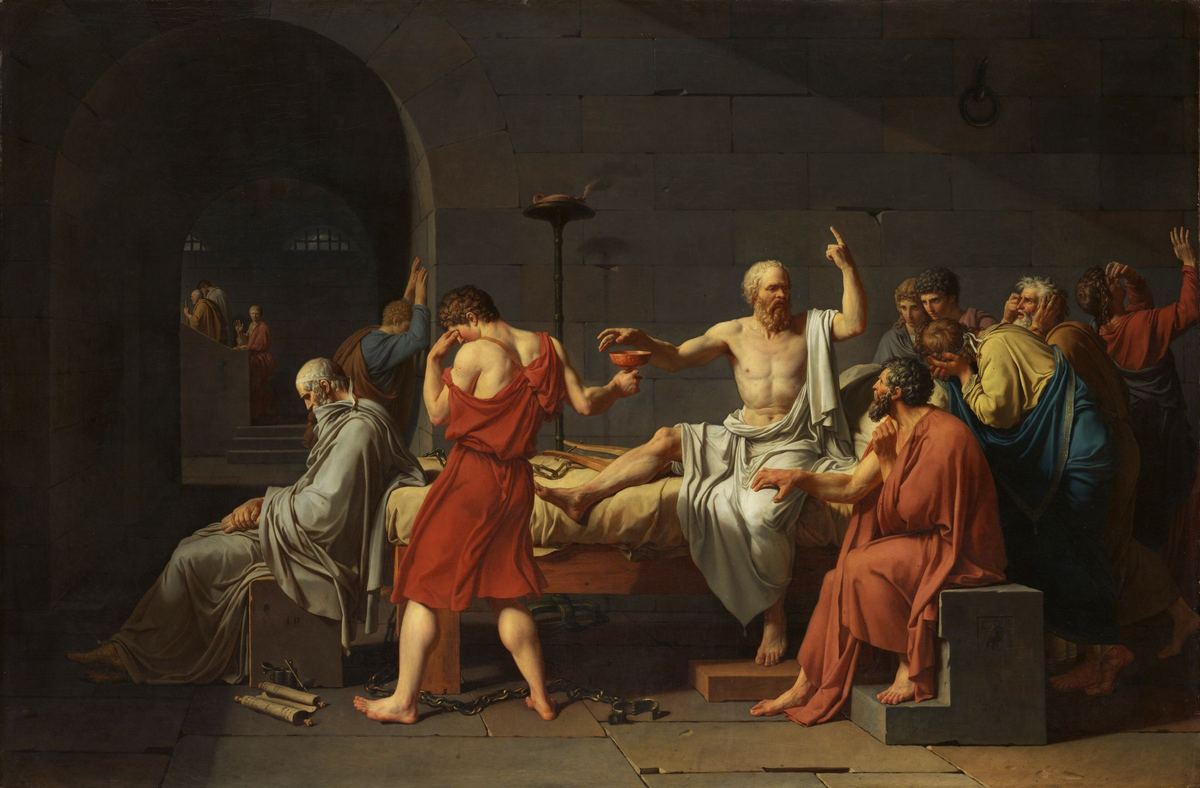
Socrates
Socrates (469–399 BCE) wrote nothing. We know him mainly through the dialogues of his student Plato. His method, the elenchus (cross-examination), is still the model for critical questioning:
- Someone claims to know what a concept is (courage, piety, justice).
- Socrates asks for a definition.
- He draws out consequences of the definition that the person also accepts.
- He shows that these consequences contradict the definition, or each other.
- The person must revise the definition, and the process repeats. Often the dialogue ends in aporia: puzzlement, with no satisfactory definition found.
In the Euthyphro, for example, Euthyphro defines piety as “what the gods love.” Socrates asks the famous question: Is something pious because the gods love it, or do the gods love it because it is pious? Either answer creates problems for Euthyphro’s definition. This is the Euthyphro dilemma, still discussed in ethics.
When the Oracle at Delphi declared that no one was wiser than Socrates, he was puzzled, because he believed he knew nothing. After questioning politicians, poets, and craftsmen, he concluded that his wisdom consisted in this: “I do not think I know what I do not know” (Apology 21d). This Socratic ignorance is the starting point of intellectual humility. See Epistemic humility and confidence.
Socrates was tried and executed in 399 BCE for impiety and corrupting the young. At his trial, according to Plato, he said: “The unexamined life is not worth living for a human being” (Apology 38a).
Plato
Plato (c. 428–348 BCE) set the agenda for much of epistemology. Three dialogues matter most.
The Meno. Meno asks whether virtue can be taught, and the discussion raises Meno’s paradox (80d–e): How can you search for something you do not know? If you don’t know what it is, you won’t recognize it when you find it. If you do know what it is, you don’t need to search. Plato’s answer is the theory of recollection: the soul knew everything before birth, and learning is remembering. He illustrates it with a slave boy who, through questioning alone, works out how to double the area of a square. Few philosophers accept recollection today, but the paradox of inquiry remains a real puzzle about how discovery is possible.
The Meno also contains the first clear statement of the difference between knowledge and true belief (97a–98a). A person with a true opinion about the road to Larissa will guide you there just as well as someone who knows the road. So why is knowledge better? Socrates answers with an image: true opinions are like the statues of Daedalus, which were said to run away unless tied down. True opinions “are not worth much until one ties them down by working out the reason” (aitias logismos). Once tied down, they become knowledge and stay in place. This is the ancestor of the justified true belief analysis and of the value problem.
The Theaetetus. This is the first sustained work of epistemology in the West. Socrates and the young mathematician Theaetetus examine three definitions of knowledge:
- Knowledge is perception. Rejected. Among other problems, it collapses into Protagorean relativism, and we can know things (such as that two sounds are different) that no single sense perceives.
- Knowledge is true judgment. Rejected with the jury example (201a–c): a skilled lawyer can persuade a jury to a true verdict about a crime only an eyewitness could know. The jurors have true judgment but not knowledge.
- Knowledge is true judgment with an account (logos). Rejected after several interpretations of “account” fail. For example, if an account means stating the distinguishing mark of the thing, then the “true judgment” must already have included that mark, and the definition becomes circular.
The dialogue ends without an answer. Twenty-three centuries later, Edmund Gettier showed that the third definition, in its modern form, still fails. See The Gettier problem.
The Republic. In Books V–VII, Plato distinguishes knowledge (epistēmē), which is of the unchanging Forms (perfect, eternal ideas such as Justice itself or the Circle itself), from opinion (doxa), which is of the changing physical world. The Divided Line ranks cognitive states from imagining (images, shadows) through belief (physical things) to thought (mathematical objects) and understanding (the Forms). The Allegory of the Cave dramatizes the same idea: prisoners chained in a cave see only shadows on the wall and take them for reality. One prisoner is freed, climbs painfully into the sunlight, and eventually sees the sun itself. If he returns to tell the others, they will think him mad and may kill him.
The cave remains a powerful image for critical thinking: our ordinary picture of the world may be a set of shadows cast by forces we cannot see, and leaving the cave is uncomfortable. It also carries a warning that works in both directions. Every conspiracy theorist believes they are the freed prisoner.
Aristotle
Aristotle (384–322 BCE), Plato’s student, brought epistemology down to earth. Where Plato distrusted the senses, Aristotle held that knowledge begins with perception. From many perceptions comes memory, from many memories comes experience, and from experience we grasp universal principles (Posterior Analytics II.19).
Several of his contributions matter for this guide.
- Logic. Aristotle invented formal logic. The Prior Analytics develops the theory of the syllogism (“All humans are mortal; Socrates is a human; therefore Socrates is mortal”). It was the dominant logic in the West until the 19th century. See Categorical logic and syllogisms.
- Scientific knowledge and the regress. In the Posterior Analytics (I.3), Aristotle considers the argument that knowledge is impossible because every demonstration requires premises that must be demonstrated in turn, forever. His reply is the first version of foundationalism: not all knowledge is demonstrative. The first principles of a science are known directly, by intellectual insight (nous), not by further demonstration. See The regress problem.
- Fallacies. On Sophistical Refutations is the first catalogue of fallacies. Aristotle lists thirteen, six that depend on language (such as equivocation and amphiboly) and seven that do not (such as begging the question and false cause). Many of the names in Chapter 15 come from this list via the medieval Latin tradition.
- Intellectual virtues. In the Nicomachean Ethics (Book VI), Aristotle distinguishes scientific knowledge (epistēmē), craft (technē), practical wisdom (phronēsis), intuitive understanding (nous), and theoretical wisdom (sophia). This is a source for modern virtue epistemology.
- Appropriate precision. “It is the mark of an educated person to look for precision in each class of things just so far as the nature of the subject admits” (Nicomachean Ethics I.3, 1094b24). Ethics and politics cannot be as exact as mathematics. Demanding mathematical proof in every domain is a mistake, and so is accepting loose reasoning where precision is available.
- Rhetoric. Aristotle’s Rhetoric identifies three modes of persuasion: ethos (the character of the speaker), pathos (the emotions of the audience), and logos (the argument itself). Critical thinkers learn to separate the three. See The core loop.
The Hellenistic schools
After Aristotle, Greek philosophy divided into schools that argued intensely about whether knowledge is possible.
The Stoics (founded by Zeno of Citium, c. 300 BCE) held that some perceptions carry a mark of their own truth. They called these cognitive impressions (phantasia katalēptikē): impressions that come from what exists, match it exactly, and are of a kind that could not come from anything that did not exist. The wise person assents only to cognitive impressions and so never errs.
The Academic skeptics, who took over Plato’s Academy, attacked this idea. Arcesilaus (c. 316–241 BCE) and Carneades (214–129 BCE) argued that for any impression, however clear, there could be an indistinguishable false one: identical twins, two eggs, a dream. So no impression carries a guaranteed mark of truth, and the wise person should withhold assent. Carneades developed a doctrine of the persuasive or plausible impression (pithanon) as a guide to action. This is an early theory of acting on probabilities rather than certainties. On an embassy to Rome in 155 BCE, Carneades famously lectured in praise of justice one day and against it the next, to show that arguments could be built on either side.
Pyrrhonism, named after Pyrrho of Elis (c. 360–270 BCE), who traveled with Alexander the Great to India, is the most radical form of ancient skepticism. Its main surviving text is Sextus Empiricus’s Outlines of Pyrrhonism (c. 200 CE). Pyrrhonists aimed at suspension of judgment (epochē) on every question, which they claimed brings tranquillity (ataraxia). Their tools were the modes: standard patterns of argument for producing suspension. The Five Modes of Agrippa (disagreement, infinite regress, relativity, hypothesis, circularity) are the ancestor of the regress problem and still frame the debate about justification. See Agrippa’s trilemma and Pyrrhonian skepticism.
The Epicureans took the opposite line: all perceptions are true, and error comes only from the judgments we add to them.
Our knowledge of much of this debate comes from Cicero’s Academica (45 BCE). When Sextus Empiricus was translated into Latin and printed in the 1560s, it helped trigger the skeptical crisis that shaped modern philosophy.
Epistemology in India
Indian philosophy developed a highly sophisticated epistemology, organized around the concept of a pramāṇa (Sanskrit: “means of valid knowledge”). A pramāṇa is a reliable way of coming to know. The schools of classical Indian philosophy (the darśanas) disagreed about how many pramāṇas there are:
| School | Accepted pramāṇas |
|---|---|
| Cārvāka (materialists) | Perception (pratyakṣa) only |
| Buddhist epistemologists (Dignāga, c. 480–540 CE; Dharmakīrti, c. 7th century CE) | Perception and inference (anumāna) |
| Sāṃkhya | Perception, inference, testimony (śabda) |
| Nyāya | Perception, inference, comparison or analogy (upamāna), testimony |
| Mīmāṃsā (Bhāṭṭa) and Advaita Vedānta | The above plus postulation (arthāpatti) and non-apprehension (anupalabdhi) |
This is an early, explicit version of the question of the sources of knowledge. The Cārvāka argued that inference is unreliable because we can never survey all instances to confirm a universal rule (“wherever there is smoke there is fire”). That is a version of the problem of induction, stated well before Hume.
The Nyāya school, whose founding text, the Nyāya Sūtra, is attributed to Akṣapāda Gautama (c. 2nd century CE), developed a detailed theory of inference, including a five-step form of argument and a classification of fallacious reasons (hetvābhāsa, “pseudo-reasons”). The standard example is: “The hill has fire, because it has smoke; wherever there is smoke there is fire, as in a kitchen; the hill has smoke; therefore the hill has fire.” Gautama also held that testimony is a distinct means of knowledge, not a disguised inference: understanding what a knowledgeable, well-intentioned speaker tells you is enough to come to know it, whoever the speaker is. This is an early version of what is now called the direct or anti-reductionist view of testimony (see Anti-reductionism). The later Nyāya philosopher Gaṅgeśa (14th century), in his Tattvacintāmaṇi (Jewel of Reflection on Reality), developed a sophisticated theory of knowledge that included a causal account of how knowledge arises, centuries before the causal theory of knowing appeared in Western philosophy (see The causal theory).
Nāgārjuna (c. 150–250 CE), the great Madhyamaka Buddhist philosopher, challenged the whole enterprise in his Vigrahavyāvartanī (The Dispeller of Disputes): if the pramāṇas establish their objects, what establishes the pramāṇas? If another pramāṇa, we face a regress; if they establish themselves, why can’t objects establish themselves too? This anticipates the problem of the criterion.
Indian philosophers also discussed cases very like the modern Gettier cases. The Buddhist philosopher Dharmottara, writing around 770 CE, described a traveler who sees a mirage, believes there is water ahead, and by luck finds water hidden under a rock at that very spot. The belief is true and based on appearances, yet it does not seem to be knowledge. Such cases were debated by Indian and Tibetan epistemologists for centuries after him.
India also produced one of history’s most formidable skeptical dialecticians. Śrīharṣa (usually dated to the 12th century), in The Sweets of Refutation (Khaṇḍanakhaṇḍakhādya), offered techniques for refuting any positive theory whatever, many of them based on the difficulty of defining key terms, much as Socrates had pressed his interlocutors for definitions. Like Sextus Empiricus, he seems to have expected a kind of peace from giving up the attempt to establish positive doctrines. See Pyrrhonian skepticism.
The Jain tradition contributed the doctrine of anekāntavāda (“many-sidedness”): reality is complex, and any single claim captures only part of it from one standpoint. The Jains developed a sevenfold scheme of qualified assertion (syādvāda, the doctrine of “maybe” or “in some respect”). The famous parable of the blind men and the elephant, found in Jain, Buddhist, and Hindu sources, illustrates the idea: each man touches one part (trunk, leg, ear) and insists the elephant is like a snake, a pillar, or a fan. Each is partly right and wrong to deny the others. This is a useful image for perspectivism, with an important caveat: the parable only works because someone can see the whole elephant.
Epistemology in the Islamic world
Between the 9th and 13th centuries, philosophers writing in Arabic and Persian preserved, commented on, and extended Greek philosophy, and made original contributions that later reached Europe.
Ibn al-Haytham (Alhazen, c. 965–1040), working in Cairo, wrote the Book of Optics (Kitāb al-Manāẓir), which established that vision occurs when light enters the eye rather than when rays leave it. He insisted that claims be tested by controlled experiment (iʿtibār). His Doubts Concerning Ptolemy opens with the lines quoted at the top of this chapter: the seeker of truth should treat every text, including the greatest authorities, as something to attack from every side, and should also suspect himself. It is one of the finest early statements of critical method, including self-directed skepticism.
Ibn Sīnā (Avicenna, 980–1037), born near Bukhara and one of the most influential philosophers in history, proposed the “floating man” thought experiment in his Book of the Soul (part of al-Shifāʾ). Imagine a man created in an instant, fully mature, suspended in the air with his eyes covered and his limbs spread so that he touches nothing and perceives nothing. He would still be aware of his own existence, though not of his body. So self-awareness does not depend on sense perception. The argument anticipates Descartes’ cogito by six centuries.
Al-Ghazālī (1058–1111), from Tus in Khorasan, described a personal skeptical crisis in his autobiography Deliverance from Error (al-Munqidh min al-Ḍalāl). He tested his beliefs and found that the senses can be corrected by reason (the star looks small but is larger than the Earth), which raised the question of what could correct reason. Perhaps our waking life is to some higher state as dreams are to waking. He could not argue his way out of this doubt; it was lifted, he says, by “a light which God cast into my breast.” In The Incoherence of the Philosophers (Tahāfut al-Falāsifa), he argued that we never observe a necessary connection between cause and effect, only that one follows the other. When cotton touches fire we observe burning with the contact, not through it. This anticipates Hume’s analysis of causation by about 650 years, although al-Ghazālī’s motive was theological (to leave room for God’s direct action).
Ibn Rushd (Averroes, 1126–1198), in Córdoba, replied in The Incoherence of the Incoherence and argued in the Decisive Treatise that philosophy and revelation, properly understood, cannot conflict.
Shihāb al-Dīn Suhrawardī (1154–1191), founder of the Illuminationist (Ishrāqī) school, developed the theory of knowledge by presence (ʿilm ḥuḍūrī): the self knows itself not by forming a representation of itself but by being immediately present to itself. This contrasts with acquired or representational knowledge (ʿilm ḥuṣūlī), which works through concepts and images. The distinction was developed by Mullā Ṣadrā (c. 1571–1640) and remains central in Iranian philosophy. See Knowledge by presence.
Epistemology in China
Classical Chinese thought focused less on defining knowledge than on how to know how to act well, but it contains important epistemological ideas.
Confucius (551–479 BCE): “When you know something, to hold that you know it; when you do not know something, to allow that you do not know it: this is knowledge” (Analects 2.17). It is a close parallel to Socratic ignorance.
The Mohists (followers of Mozi, 5th–3rd centuries BCE) proposed three standards (sān biǎo) for evaluating claims: their basis (do they fit the deeds of the ancient sage-kings?), their source (do they fit what ordinary people have seen and heard?), and their application (do they benefit the people when put into practice?). The later Mohist Canons contain careful discussions of definitions, argument, and the kinds of knowledge (by hearsay, by explanation, by personal experience).
Zhuangzi (c. 369–286 BCE) wrote the famous butterfly dream: “Once Zhuang Zhou dreamed he was a butterfly... Suddenly he awoke, and there he was, unmistakably Zhuang Zhou. But he did not know whether he was Zhuang Zhou who had dreamed he was a butterfly, or a butterfly dreaming it was Zhuang Zhou.” In the “happy fish” debate, Zhuangzi remarks that the fish are happy; his friend Huizi objects, “You are not a fish; how do you know the fish are happy?” Zhuangzi replies, “You are not me; how do you know I don’t know?” These are early versions of dream skepticism and the problem of other minds.
Xunzi (c. 310–235 BCE) wrote a chapter titled Jiebi (usually translated “Dispelling Obsession” or “Undoing Fixation”) about how the mind becomes “blinded” by one-sided attachment: fixation on desire or aversion, on the near or the far, on the past or the present. A clear, calm mind, like still water, reflects things accurately. It is one of the earliest theories of cognitive bias.
Medieval and Renaissance Europe
Augustine of Hippo (354–430) wrote Against the Academics (386) to refute skepticism. In The City of God (XI.26) he argued: si fallor, sum, “if I am mistaken, I exist.” Even a deceived person must exist to be deceived. This is another anticipation of the cogito. Augustine also held that certain truths are known by divine illumination.
Thomas Aquinas (1225–1274) synthesized Aristotle with Christian theology. He adopted Aristotle’s empiricism: the scholastic slogan “nothing is in the intellect that was not first in the senses” (nihil est in intellectu quod non sit prius in sensu) appears in his Disputed Questions on Truth. He distinguished truths knowable by natural reason from truths known only by revelation.
William of Ockham (c. 1287–1347) gave his name to Ockham’s razor, the principle of not multiplying entities beyond necessity. The famous wording (“entities must not be multiplied beyond necessity”) comes from later writers, but Ockham used similar principles often. See Philosophical razors and heuristics. Nicholas of Autrecourt (c. 1300–1369) argued, like al-Ghazālī before and Hume after him, that we cannot infer the existence of one thing from the existence of another with certainty. His views were condemned by church authorities in the 1340s.
In the Renaissance, Michel de Montaigne (1533–1592) revived Pyrrhonism in his Essays (1580), especially the “Apology for Raymond Sebond.” His motto was Que sais-je?, “What do I know?”
Francis Bacon (1561–1626), in the Novum Organum (1620), argued for a new method of inquiry based on careful observation and experiment. He also identified four idols (false notions) that distort human understanding:
- Idols of the Tribe: errors common to human nature, such as seeing more order than exists and noticing confirming instances while ignoring others.
- Idols of the Cave: individual biases from temperament, education, and habit.
- Idols of the Marketplace: errors arising from language, from words that are vague or name non-existent things.
- Idols of the Theatre: errors from received philosophical systems and dogmas.
His description of the first is a precise account of confirmation bias, written about 340 years before psychologists named it:
“The human understanding when it has once adopted an opinion ... draws all things else to support and agree with it. And though there be a greater number and weight of instances to be found on the other side, yet these it either neglects and despises, or else by some distinction sets aside and rejects.” (Novum Organum I.46)
The early modern revolution
The 17th and 18th centuries are the classical period of epistemology. The new science of Galileo and Newton had overturned ancient authorities, the Reformation had split Europe over the question of religious authority, and Pyrrhonist texts were circulating again. Philosophers asked: what, if anything, can we know with certainty, and how?
It is easy to forget how different the older way of thinking was. Much Renaissance thought looked for knowledge in correspondences between humanity and the cosmos. When Galileo reported in 1610 that his telescope showed moons orbiting Jupiter, the scholar Francesco Sizzi replied that there could be only seven “planets” (moving heavenly bodies), because there are seven openings in the head (two eyes, two ears, two nostrils, a mouth), seven metals, and seven days of the week. Jennifer Nagel (Knowledge: A Very Short Introduction, ch. 3) uses the episode to show what the Modern revolution replaced: pattern-seeking analogy was replaced by systematic observation and mathematical modeling. The pull of meaningful-seeming patterns has not gone away (see Texas sharpshooter and False analogy).
Historians traditionally sort the figures of this period into rationalists (Descartes, Spinoza, Leibniz), who held that reason is the main source of knowledge and that some ideas are innate, and empiricists (Locke, Berkeley, Hume), who held that all knowledge comes from experience. The labels simplify a great deal (Locke valued reason; Descartes did experiments), but they mark a real disagreement. Kant tried to reconcile the two sides.
Descartes and the quest for certainty
René Descartes (1596–1650) is often called the father of modern philosophy. His Meditations on First Philosophy (1641) is the single most influential work in the history of epistemology.
Descartes wanted to rebuild knowledge on a foundation that could not be doubted. His method of doubt was to reject any belief open to the slightest doubt, not because such beliefs are false but in order to find out what, if anything, survives. In the First Meditation he escalates the doubt in three stages:
- The senses sometimes deceive (a tower looks round from afar but is square up close). But it would be foolish to doubt, on this basis, that I am sitting by the fire in my dressing gown.
- The dream argument. “There are never any sure signs by means of which being awake can be distinguished from being asleep.” So I cannot be sure I am sitting by the fire. But even in dreams, simple truths like 2 + 3 = 5 seem to hold.
- The evil demon (genius malignus). Suppose “some malicious demon of the utmost power and cunning has employed all his energies in order to deceive me.” Then even my arithmetic could be wrong.
In the Second Meditation, Descartes finds one thing the demon cannot touch. If I am being deceived, I must exist to be deceived: “I am, I exist, is necessarily true whenever it is put forward by me or conceived in my mind.” The famous formula cogito, ergo sum (“I think, therefore I am”) appears in the Principles of Philosophy (1644), and the French je pense, donc je suis in the Discourse on Method (1637).
From the cogito, Descartes extracts a rule: whatever I perceive clearly and distinctly is true. But to guarantee that rule against the demon, he argues that a perfect, non-deceiving God exists. Antoine Arnauld objected that Descartes relies on clear and distinct perception to prove God exists, and relies on God to guarantee clear and distinct perception. This is the Cartesian circle. Other critics pressed different points: Princess Elisabeth of Bohemia, in a searching correspondence beginning in 1643, asked how an immaterial mind could possibly move a material body, and Thomas Hobbes asked what “innate ideas” could actually be.
Descartes also explained where error comes from. Clear and distinct ideas (of numbers, shapes, and God) cannot mislead us; sensations of color, heat, and taste are “obscure and confused” and were given to us to protect the body, not to reveal the nature of things. Error arises when our free will leaps ahead of our understanding and assents to what is not clear and distinct. His illustration of the difference between intellect and imagination is memorable: you can think of a chiliagon, a figure with exactly a thousand sides, with perfect precision, but you cannot picture one that looks any different from a figure with 999 sides.
Descartes’ legacy includes:
- Foundationalism: knowledge as a building on indubitable foundations. See Classical foundationalism.
- Internalism: justification must be accessible from the first-person point of view. See Internalism and externalism.
- The external-world problem: how can I get from my own mind to knowledge of anything outside it? See Cartesian skepticism.
Spinoza and Leibniz
Baruch Spinoza (1632–1677), in the Ethics (published 1677), distinguished three kinds of knowledge: imagination or opinion (from the senses and hearsay, liable to error), reason (from adequate general ideas), and intuitive knowledge (the highest, which grasps things directly in their relation to God or Nature). He held that “truth is the standard both of itself and of the false”: a true idea carries its own certainty.
Gottfried Wilhelm Leibniz (1646–1716) distinguished truths of reason (necessary, whose opposite is impossible, like mathematics) from truths of fact (contingent, whose opposite is possible). He relied on the principle of sufficient reason: nothing is so without a reason why it is so and not otherwise. Against Locke’s blank slate, Leibniz argued in the New Essays on Human Understanding (written 1704, published 1765) that the mind is more like a block of marble with veins that dispose it to take certain shapes. Innate ideas are present as dispositions.
Locke
John Locke (1632–1704) set out, in An Essay Concerning Human Understanding (1689), to “search out the bounds between opinion and knowledge” by a “historical, plain method”: studying how human minds actually acquire their ideas. Part of his motive was political. If we knew where knowledge ends and mere opinion begins, we would see that on many disputed matters, especially in religion, no one is entitled to certainty, and so no one is entitled to persecute others for disagreeing. His Letter Concerning Toleration appeared the same year.
Locke opened the Essay with an attack on innate ideas. If any principle were innate, all people would assent to it, and children and “idiots” do not assent even to “whatever is, is.” A child knows that a stranger is not its mother long before it could grasp the abstract principle that nothing can both be and not be. Instead, the mind at birth is like “white paper, void of all characters.” All ideas come from experience, either sensation (of external things) or reflection (on the mind’s own operations).
Jennifer Nagel (Knowledge, ch. 3) suggests a useful way of seeing the contrast between Descartes and Locke. Descartes works from the first-person point of view, asking “What can I know for certain?”, and from that angle the clearest knowledge is purely rational and independent of the outer world. Locke often adopts a third-person point of view, asking “What do human beings know, and how do they come to know it?”, and from that angle, perception, understood as a relation between a person and their environment, looks like the natural foundation. The same contrast reappears in contemporary epistemology as the debate between internalism and externalism.
Locke distinguished primary qualities (solidity, extension, shape, motion, number), which exist in objects as we perceive them, from secondary qualities (colors, sounds, tastes, smells), which are powers in objects to produce sensations in us but do not resemble those sensations. Grass is not green in the way it looks green. See Primary and secondary qualities.
Locke defined knowledge as “the perception of the connexion and agreement, or disagreement and repugnancy, of any of our ideas” (Essay IV.i.2). He recognized three degrees: intuitive (immediate), demonstrative (by a chain of intuitions), and sensitive (of particular external things, less certain). Beyond knowledge lies probability, and Locke gave an early theory of how to proportion assent to evidence, including the evidence of testimony, which he thought could deliver only probable “judgment,” never knowledge (see Locke: testimony gives only probability). His “love of truth” passage is an early statement of the ethics of belief: the mark of a lover of truth is “not entertaining any proposition with greater assurance than the proofs it is built upon will warrant” (IV.xix.1).
Locke’s friend William Molyneux posed a famous question, included in the second edition of the Essay (1694): if a man born blind, who had learned to tell a cube from a sphere by touch, were suddenly given sight, could he tell them apart by sight alone? Locke and Molyneux said no. (Molyneux’s problem has since been studied empirically. A 2011 study of patients who gained sight after surgery found they could not immediately match objects across sight and touch, but learned quickly.)
Berkeley
George Berkeley (1685–1753), an Irish bishop, pushed empiricism to a startling conclusion in A Treatise Concerning the Principles of Human Knowledge (1710) and Three Dialogues between Hylas and Philonous (1713). He argued that Locke’s primary qualities are no different from secondary ones: shape and size also vary with the perceiver. And we can never compare an idea with something that is not an idea. So there is no reason to believe in material substance existing outside minds. To be is to be perceived: esse est percipi. Objects continue to exist when no human perceives them because God always perceives them. The view is called immaterialism or subjective idealism.
When James Boswell remarked that Berkeley’s theory was impossible to refute, Samuel Johnson kicked a large stone and said, “I refute it thus.” Berkeley, of course, did not deny that stones feel hard; he denied only that the hardness exists outside of perception. Johnson’s kick is a classic example of missing the point of an argument. It is also, in its way, a precursor of Moore’s appeal to common sense.
Hume
David Hume (1711–1776) is probably the most important philosopher for anyone who wants to think critically. His A Treatise of Human Nature (1739–40) “fell dead-born from the press,” as he put it, so he rewrote the epistemology as An Enquiry Concerning Human Understanding (1748).
Hume divided mental contents into impressions (vivid perceptions and feelings) and ideas (fainter copies of impressions). According to his copy principle, every simple idea derives from a prior impression. To test whether a word has meaning, ask: from what impression is this idea derived?
Hume’s fork divides all objects of inquiry into two kinds:
- Relations of ideas: mathematics and logic, knowable by thought alone, certain, and denying them implies a contradiction.
- Matters of fact: everything else, knowable only by experience, never certain, and their denial is always conceivable.
Hume’s most famous arguments follow from these tools.
- Causation. When we see one billiard ball strike another, we observe the first ball move, the contact, and the second ball move. We never observe a necessary connection or power. Our idea of necessary connection comes from a feeling of expectation produced by custom or habit after we have seen the constant conjunction of two kinds of events. See Hume and the regularity view.
- The problem of induction. All reasoning about matters of fact beyond present experience relies on the assumption that the future will resemble the past. But that assumption is not a relation of ideas (its denial is conceivable) and cannot be proven by experience without circularity. So inductive inference has no rational foundation. We do it from custom. This is the single most famous problem in the philosophy of science. See Hume’s problem of induction.
- Miracles. In Section X of the Enquiry, Hume argues that “a wise man proportions his belief to the evidence.” Since the laws of nature are supported by uniform experience, “no testimony is sufficient to establish a miracle, unless the testimony be of such a kind, that its falsehood would be more miraculous, than the fact, which it endeavours to establish.” This is the forerunner of the modern maxim “extraordinary claims require extraordinary evidence.” See Philosophical razors and heuristics.
- Is and ought. In the Treatise (3.1.1), Hume observed that moral writers move from statements about what is to statements about what ought to be without explaining how. This is–ought gap is essential for analyzing policy debates. See Facts, values, and the is-ought gap.
- Reason and passion. “Reason is, and ought only to be the slave of the passions” (Treatise 2.3.3). Reason can tell us how to get what we want, but it cannot by itself tell us what to want.
Hume’s skepticism was mitigated. He thought nature is “too strong for principle”: we cannot help believing in the external world and in induction, whatever philosophy says. “Be a philosopher; but, amidst all your philosophy, be still a man.” He ends the Enquiry with a famous test for any book: “Does it contain any abstract reasoning concerning quantity or number? No. Does it contain any experimental reasoning concerning matter of fact and existence? No. Commit it then to the flames: for it can contain nothing but sophistry and illusion.”
Reid and common sense
Thomas Reid (1710–1796), Hume’s Scottish contemporary, argued that the whole modern tradition had gone wrong with the “way of ideas”: the assumption that we perceive only our own ideas and must infer the external world from them. Once you accept that, skepticism follows. Reid instead defended direct realism about perception and a set of first principles of common sense that we are entitled to trust without proof: that our faculties are reliable, that other people have minds, that the future will resemble the past, and so on.
Reid’s parity argument is a sharp reply to the skeptic:
“Reason, says the skeptic, is the only judge of truth, and you ought to throw off every opinion and every belief that is not grounded on reason. Why, sir, should I believe the faculty of reason more than that of perception? They came both out of the same shop, and were made by the same artist; and if he puts one piece of false ware into my hands, what should hinder him from putting another?” (An Inquiry into the Human Mind, 1764, VI.20)
Reid also proposed that we trust testimony by a natural principle of credulity, matched by a principle of veracity (a natural tendency to tell the truth). He is the ancestor of anti-reductionism about testimony, of Mooreanism, and of modern reliabilism. His reputation declined in the 19th century and has risen steeply since the 1980s.
Kant
Immanuel Kant (1724–1804) said that reading Hume “interrupted my dogmatic slumber.” In the Critique of Pure Reason (1781; 2nd ed. 1787), he set out to show how synthetic a priori knowledge is possible, answering Hume without returning to the old rationalism. See Three great distinctions.
His solution was a “Copernican revolution” in philosophy. Instead of assuming that our knowledge must conform to objects, suppose that objects, as we experience them, must conform to the structure of our minds. The mind contributes:
- Forms of intuition, space and time, which structure all sensory experience.
- Categories of the understanding, such as substance, causality, and unity, which structure all thought about objects.
Because every possible experience must conform to these structures, we can know a priori that every event we experience has a cause and occurs in space and time. The price is transcendental idealism: we know things only as they appear to us (phenomena), never as they are in themselves (noumena).
“Thoughts without content are empty, intuitions without concepts are blind” (A51/B75). Knowledge requires both the senses (which give content) and the understanding (which gives form). Kant thereby tried to reconcile empiricism and rationalism.
Kant’s short essay “An Answer to the Question: What Is Enlightenment?” (1784) contains the motto of critical thinking: Sapere aude! “Dare to know! Have courage to use your own understanding!” Enlightenment, he wrote, is humanity’s emergence from self-incurred immaturity, “the inability to use one’s own understanding without the guidance of another.”
The nineteenth century
Hegel, Mill, and Whewell
G. W. F. Hegel (1770–1831), in the Phenomenology of Spirit (1807), treated knowledge as developing historically through a series of forms of consciousness, each of which breaks down under its own internal tensions and gives way to a more adequate one. He mocked the idea of examining our faculty of knowledge before using it: that is like wanting to learn to swim before going into the water.
John Stuart Mill (1806–1873) was a radical empiricist. In A System of Logic (1843) he argued that even mathematics is ultimately based on induction from experience. He systematized Mill’s methods for discovering causes (agreement, difference, joint method, residues, concomitant variation), still taught today. See Mill’s methods. In On Liberty (1859), chapter 2, Mill gave the classic epistemic argument for freedom of speech:
“He who knows only his own side of the case, knows little of that. His reasons may be good, and no one may have been able to refute them. But if he is equally unable to refute the reasons on the opposite side; if he does not so much as know what they are, he has no ground for preferring either opinion.”
Mill argued that silencing an opinion is wrong even if the opinion is false, because (1) it might be true, (2) it might contain part of the truth, (3) even a true belief, unchallenged, becomes a “dead dogma” held as prejudice, and (4) its meaning is lost when its reasons are forgotten. This is one of the strongest arguments for steelmanning.
William Whewell (1794–1866), who coined the word “scientist,” argued that scientific discovery involves the creative colligation of facts under a new idea, and that the strongest evidence for a theory is the consilience of inductions: when a theory built to explain one class of facts unexpectedly explains a different class too.
Peirce, James, and Dewey: pragmatism
Charles Sanders Peirce (1839–1914), an American logician and scientist, founded pragmatism. In “The Fixation of Belief” (1877) he argued that doubt is an uneasy state we struggle to escape, and that belief is a habit of action. He compared four methods of settling belief:
- Tenacity: clinging to what you already believe and avoiding contrary evidence.
- Authority: letting an institution dictate belief.
- The a priori method: believing what is “agreeable to reason” or congenial.
- The method of science: letting belief be determined by something external to us, “by some external permanency—by something upon which our thinking has no effect.”
Only the fourth, Peirce argued, is self-correcting. It is the only method under which you can be wrong in a way that you can discover.
In “How to Make Our Ideas Clear” (1878), Peirce proposed the pragmatic maxim: our conception of an object is our conception of its practical effects. If two theories make no difference to any possible experience, they do not really differ. Peirce named abduction, inference to an explanatory hypothesis, as a third form of reasoning alongside deduction and induction (see Deduction, induction, and abduction). He was a thorough fallibilist and inscribed a rule “on every wall of the city of philosophy”: Do not block the way of inquiry.
William James (1842–1910) popularized pragmatism, sometimes in ways Peirce disliked. In Pragmatism (1907) he described truth in terms of what “works,” a formulation that invited misunderstanding. His essay “The Will to Believe” (1896) replied to W. K. Clifford’s “The Ethics of Belief” (1877). This debate is examined in Chapter 13.
John Dewey (1859–1952) treated knowledge as the outcome of inquiry, a process that starts from a problematic situation and ends when the situation is resolved (Logic: The Theory of Inquiry, 1938). His book How We Think (1910) defined reflective thinking as “active, persistent, and careful consideration of any belief or supposed form of knowledge in the light of the grounds that support it and the further conclusions to which it tends.” This definition is often cited as the start of the modern critical-thinking movement in education.
Nietzsche
Friedrich Nietzsche (1844–1900) developed perspectivism: “There is only a perspective seeing, only a perspective ‘knowing’; and the more affects we allow to speak about one thing, the more eyes, different eyes, we can use to observe one thing, the more complete will our ‘concept’ of this thing, our ‘objectivity,’ be” (On the Genealogy of Morals, 1887, III.12). Note that this is not simple relativism. Nietzsche suggests that objectivity is achieved by combining perspectives, which is close to what modern social epistemology says about diversity in inquiry. He also practiced a style of genealogical critique: asking what psychological and social needs a belief serves. This is powerful and dangerous, since it easily becomes the genetic fallacy.
The twentieth century
Frege, Russell, and the new logic
Gottlob Frege (1848–1925) invented modern logic in his Begriffsschrift (1879), with quantifiers and variables, the logic taught in Chapter 3. He tried to derive arithmetic from logic (logicism) and distinguished the sense and reference of expressions (“On Sense and Reference,” 1892). See Sense and reference.
Bertrand Russell (1872–1970) discovered the paradox that wrecked Frege’s system (the set of all sets that are not members of themselves). With Alfred North Whitehead he wrote Principia Mathematica (1910–13). His theory of definite descriptions (“On Denoting,” 1905) became a model of philosophical analysis. In epistemology he distinguished knowledge by acquaintance and by description and wrote The Problems of Philosophy (1912), which is still one of the best introductions to the subject. His chicken is a memorable image of the problem of induction: “The man who has fed the chicken every day throughout its life at last wrings its neck instead, showing that more refined views as to the uniformity of nature would have been useful to the chicken” (ch. 6). In Human Knowledge: Its Scope and Limits (1948) he described a man who looks at a stopped clock that happens to show the right time, which is now read as an early Gettier case.
Logical positivism
The Vienna Circle (Moritz Schlick, Rudolf Carnap, Otto Neurath, and others, 1920s–30s) and A. J. Ayer’s Language, Truth and Logic (1936) defended logical positivism. Its central doctrine was the verification principle: a statement is meaningful only if it is either analytic (true by definition) or empirically verifiable. Metaphysics, theology, and ethics, which fit neither category, were declared literally meaningless.
The movement collapsed for several reasons. The most famous is self-refutation: the verification principle itself is neither analytic nor empirically verifiable, so by its own standard it is meaningless. Formulating the principle precisely also proved impossible; every version either excluded parts of science or let in metaphysics. Still, the positivists’ demand, “What observation would count for or against this?”, remains a useful critical question, and it led directly to Popper’s falsifiability criterion.
Otto Neurath contributed an image that became central to later epistemology: “We are like sailors who have to rebuild their ship on the open sea, without ever being able to dismantle it in dry-dock and reconstruct it from the best materials” (“Protocol Sentences,” 1932). There is no place outside our web of beliefs from which to rebuild it; we must repair it plank by plank while it floats. Neurath’s boat is the emblem of coherentism and of Quine’s naturalism.
Popper
Karl Popper (1902–1994) rejected the positivists’ criterion of meaning but offered a criterion of science: falsifiability. A theory is scientific if it forbids some possible observations. Einstein’s theory of general relativity made a risky prediction (starlight bends near the sun by a specific amount), which was tested by Eddington’s eclipse expedition in 1919. By contrast, Popper argued, Freudian psychoanalysis and Adlerian psychology could explain any possible behavior, which he saw as a weakness, not a strength. Popper also denied that science uses induction at all: it proceeds by conjectures and refutations. His general philosophy, critical rationalism, holds that no belief can be justified, but all can be criticized, and rationality consists in exposing our beliefs to criticism. His works include The Logic of Scientific Discovery (1934; English 1959), The Open Society and Its Enemies (1945), and Conjectures and Refutations (1963). See Popper and falsificationism and Critical rationalism.
Wittgenstein and Moore
G. E. Moore (1873–1958) defended common sense against skepticism and idealism. In “A Defence of Common Sense” (1925) he listed truisms he knew with certainty: that he has a body, that it has existed for some time, that there are other people. In “Proof of an External World” (1939) he held up his hands and said, “Here is one hand, and here is another,” concluding that external things exist. Many found this question-begging. Moore’s point was that he was more certain of his hands than of any premise in a skeptical argument. See Mooreanism.
Ludwig Wittgenstein (1889–1951) produced two very different philosophies. The Tractatus Logico-Philosophicus (1921) offered a picture theory of meaning and ended: “Whereof one cannot speak, thereof one must be silent.” The Philosophical Investigations (published 1953) rejected much of this in favor of the view that meaning is use within language games embedded in forms of life, and introduced the idea of family resemblance concepts (see Family resemblance and prototypes).
In his last notes, published as On Certainty (1969), Wittgenstein responded to Moore. He argued that propositions like “Here is a hand” or “The Earth has existed for many years” are not things we know in the ordinary sense, because they are not the result of inquiry and could not be supported by anything more certain. They are hinges: “the questions that we raise and our doubts depend on the fact that some propositions are exempt from doubt, are as it were like hinges on which those turn” (§341). Doubt itself requires a framework of things not doubted. This is the source of hinge epistemology.
J. L. Austin (1911–1960) examined ordinary uses of “know,” noting that saying “I know” is like giving a promise: it gives others my word (“Other Minds,” 1946). Sense and Sensibilia (1962) attacked the argument from illusion.
Quine and naturalized epistemology
W. V. O. Quine (1908–2000) was the most influential American philosopher of the mid-20th century. In “Two Dogmas of Empiricism” (1951) he attacked:
- The analytic–synthetic distinction. Every attempt to define “analytic” (true by meaning, true by synonymy, true by definition) relies on other notions in the same circle.
- Reductionism: the idea that each meaningful statement can be tested individually against experience.
In place of these, Quine proposed a holistic picture: “our statements about the external world face the tribunal of sense experience not individually but only as a corporate body.” Our beliefs form a web that touches experience only at its edges. When experience conflicts with the web, we have choices about which beliefs to revise. We prefer to change beliefs near the edge and protect central ones like logic and mathematics, but “no statement is immune to revision.” This is the Duhem–Quine thesis. See The Duhem-Quine problem.
In “Epistemology Naturalized” (1969), Quine argued that the Cartesian project of justifying science from an indubitable foundation had failed and should be abandoned. Epistemology should become “a chapter of psychology”: the empirical study of how humans get from sensory input (“meager input”) to scientific theory (“torrential output”). The debate over how much normativity survives this naturalization continues. See Chapter 14.
Sellars and the myth of the given
Wilfrid Sellars (1912–1989), in “Empiricism and the Philosophy of Mind” (1956), attacked the Myth of the Given: the idea that experience provides foundations for knowledge that are both non-conceptual (not already beliefs, so not needing justification) and able to justify beliefs. Sellars posed a dilemma. If sensory experience is non-conceptual, it cannot stand in logical relations to beliefs and cannot justify them. If it is conceptual, it is itself something that could be mistaken and would need justification. Either way, it cannot be a foundation. Knowledge belongs to “the logical space of reasons, of justifying and being able to justify what one says.” See Objections to foundationalism.
Gettier and the analytic boom
In 1963 Edmund Gettier published a three-page paper, “Is Justified True Belief Knowledge?” in Analysis. It presented two counterexamples to the analysis of knowledge as justified true belief, and it launched an industry. For the next three decades, epistemologists searched for a “fourth condition” that would make the analysis Gettier-proof, which led to the causal theory, defeasibility theories, reliabilism, tracking theories, and more. See Chapter 5.
From this period also come externalism (Alvin Goldman, Fred Dretske, Robert Nozick), coherentism (Laurence BonJour, Keith Lehrer), contextualism (Stewart Cohen, Keith DeRose, David Lewis), and Roderick Chisholm’s careful internalist foundationalism.
Kuhn and the historical turn
Thomas Kuhn’s The Structure of Scientific Revolutions (1962) argued that science does not grow by steady accumulation. Periods of normal science within a shared paradigm are interrupted by revolutions in which the paradigm itself is replaced (Ptolemy to Copernicus, Newton to Einstein). Competing paradigms may be partly incommensurable. Kuhn’s work, along with that of Imre Lakatos and Paul Feyerabend, turned the philosophy of science toward history and sociology and raised hard questions about the rationality of science. See Kuhn and paradigms.
Around the same time, Richard Rorty (Philosophy and the Mirror of Nature, 1979) attacked the idea that epistemology could provide foundations for all culture, and Michel Foucault examined how regimes of “power/knowledge” shape what counts as true in institutions like medicine and prisons.
Contemporary directions
Since about 1990, epistemology has grown in several new directions:
- Virtue epistemology (Ernest Sosa, Linda Zagzebski, John Greco, Jason Baehr) focuses on the intellectual abilities and character of knowers. See Chapter 13.
- Knowledge-first epistemology (Timothy Williamson, Knowledge and Its Limits, 2000) treats knowledge as basic and uses it to explain belief, evidence, and justification. See Knowledge first.
- Social epistemology (Alvin Goldman, Knowledge in a Social World, 1999; Miranda Fricker, Epistemic Injustice, 2007) studies testimony, expertise, disagreement, and institutions. See Chapter 12.
- Formal epistemology uses probability theory, decision theory, and logic. Richard Jeffrey, Bas van Fraassen, and James Joyce developed Bayesian theories of belief and “accuracy-first” arguments. See Chapter 9.
- Feminist and standpoint epistemology (Sandra Harding, Donna Haraway, Helen Longino, Patricia Hill Collins). See Standpoint and feminist epistemology.
- Experimental philosophy tests intuitions empirically. An early study (Weinberg, Nichols, and Stich, “Normativity and Epistemic Intuitions,” 2001) reported cultural differences in Gettier intuitions, but a large later study across many countries (Machery et al., “Gettier Across Cultures,” 2017) found Gettier intuitions to be broadly shared. This is a good example of science correcting an exciting early finding. See Thought experiments and intuitions.
- Pragmatic encroachment asks whether practical stakes affect knowledge. See Pragmatic encroachment.
- Applied epistemology covers misinformation, echo chambers, conspiracy theories, polarization, and the epistemology of artificial intelligence, such as deepfakes, recommender algorithms, and large language models as sources of testimony. See Epistemic autonomy and artificial intelligence.
Timeline
| Date | Thinker | Key work or idea |
|---|---|---|
| c. 500 BCE | Xenophanes, Heraclitus, Parmenides | Fallibilism; reason versus the senses |
| c. 500 BCE | Confucius | “To know what you know and know what you don’t know” |
| 5th c. BCE | Protagoras | “Man is the measure of all things” |
| 399 BCE | Socrates (executed) | Elenchus; Socratic ignorance |
| c. 380–360 BCE | Plato | Meno, Republic, Theaetetus |
| c. 350 BCE | Aristotle | Syllogistic logic; Posterior Analytics; fallacies |
| c. 300 BCE | Zhuangzi; Mohists | Butterfly dream; three standards |
| 3rd–2nd c. BCE | Arcesilaus, Carneades | Academic skepticism |
| c. 2nd c. CE | Akṣapāda Gautama | Nyāya Sūtra: the pramāṇas; testimony as a distinct source |
| c. 150–250 CE | Nāgārjuna | Critique of the means of knowledge |
| c. 200 CE | Sextus Empiricus | Outlines of Pyrrhonism |
| 386–426 | Augustine | Against the Academics; si fallor, sum |
| 6th–7th c. | Dignāga, Dharmakīrti | Buddhist logic and epistemology |
| c. 770 | Dharmottara | Mirage and smoke cases (proto-Gettier) |
| c. 1025 | Ibn al-Haytham | Experimental method; Doubts Concerning Ptolemy |
| c. 1020s | Ibn Sīnā | Floating man |
| c. 1100 | al-Ghazālī | Deliverance from Error; critique of causal necessity |
| 12th c. | Suhrawardī | Knowledge by presence |
| 12th c. | Śrīharṣa | The Sweets of Refutation: skeptical dialectic |
| 14th c. | Gaṅgeśa | Tattvacintāmaṇi: Navya-Nyāya theory of knowledge |
| 13th c. | Aquinas | Aristotelian empiricism and theology |
| 14th c. | Ockham | Ockham’s razor |
| 1580 | Montaigne | Essays: “What do I know?” |
| 1620 | Bacon | Novum Organum: the idols |
| 1641 | Descartes | Meditations: method of doubt, cogito |
| 1689 | Locke | Essay Concerning Human Understanding |
| 1710 | Berkeley | Principles of Human Knowledge |
| 1739–48 | Hume | Treatise; Enquiry: induction, causation |
| 1764 | Reid | Inquiry: common sense |
| 1781 | Kant | Critique of Pure Reason |
| 1843 / 1859 | Mill | A System of Logic; On Liberty |
| 1877 | Peirce; Clifford | “The Fixation of Belief”; “The Ethics of Belief” |
| 1896 | James | “The Will to Believe” |
| 1912 | Russell | The Problems of Philosophy |
| 1934 | Popper | Logik der Forschung: falsifiability |
| 1936 | Ayer | Language, Truth and Logic |
| 1939 | Moore | “Proof of an External World” |
| 1951 | Quine | “Two Dogmas of Empiricism” |
| 1953 / 1969 | Wittgenstein | Philosophical Investigations; On Certainty |
| 1956 | Sellars | “Empiricism and the Philosophy of Mind” |
| 1962 | Kuhn | The Structure of Scientific Revolutions |
| 1963 | Gettier | “Is Justified True Belief Knowledge?” |
| 1974 | Tversky and Kahneman | “Judgment under Uncertainty: Heuristics and Biases” |
| 1979 | Goldman | “What Is Justified Belief?” (reliabilism) |
| 1981 | Nozick; Putnam | Tracking theory; brains in a vat |
| 1985 | BonJour | The Structure of Empirical Knowledge |
| 1996 | Zagzebski | Virtues of the Mind |
| 2000 | Williamson | Knowledge and Its Limits |
| 2007 | Fricker | Epistemic Injustice |
Recurring patterns in the history
Reading the history as a whole, you can see several arguments that return again and again in new forms. Recognizing them is a large part of philosophical literacy.
- Reason versus experience. Parmenides versus the physicists, Plato versus Aristotle, rationalists versus empiricists, Kant’s synthesis, Quine’s attack on the a priori. See Reason and the a priori.
- The regress of justification. Aristotle, Agrippa, Nāgārjuna, Descartes, Sellars, and modern foundationalists, coherentists, and infinitists. See Chapter 6.
- The skeptical challenge. Pyrrho, Zhuangzi, al-Ghazālī, Descartes, Hume, and brains in vats. See Chapter 8.
- Knowledge versus lucky true belief. Plato’s Meno and Theaetetus, Dharmottara, Russell’s clock, Gettier. See Chapter 5.
- Relativism versus objectivity. Protagoras, the Jain many-sidedness doctrine, Nietzsche, Kuhn, social constructionism. See Chapter 11.
- The individual versus the community. Descartes’ lone thinker versus Reid’s trust in testimony, Mill’s marketplace of ideas, Peirce’s community of inquirers, modern social epistemology. See Chapter 12.
- The causal link we never see. al-Ghazālī, Nicholas of Autrecourt, Hume, and modern theories of causal inference. See Causation and causal inference.
- The mind’s own distortions. Xenophanes’ gods, Xunzi’s fixations, Bacon’s idols, Kahneman’s heuristics. See Chapter 14.
Check your understanding
1What is Meno’s paradox, and why is it still a real puzzle?
Answer
If you don’t know what you are looking for, you won’t recognize it when you find it; if you do know, you don’t need to look. So inquiry seems impossible. It remains a puzzle because real inquiry works with partial knowledge: we know enough to formulate a question and recognize a good answer without already knowing the answer. Explaining how that partial knowledge guides discovery is a real problem in epistemology and in the philosophy of science.
2State the jury example from the Theaetetus. What does it show?
Answer
A skilled speaker persuades a jury of a true verdict about events only an eyewitness could know. The jurors end up with a true belief but not knowledge, because their belief is based on persuasion rather than on good grounds. It shows that true belief is not sufficient for knowledge.
3Explain Hume’s fork and use it to reconstruct his problem of induction.
Answer
Hume’s fork: all reasoning concerns either relations of ideas (a priori, certain, denial is contradictory) or matters of fact (known by experience, denial conceivable). Induction assumes the future will resemble the past (the uniformity principle). This principle is not a relation of ideas, since its denial is conceivable. It is not established by experience either, since any argument from experience would already assume it (circularity). So it has no rational support, and neither does induction.
4What is Reid’s parity argument against the skeptic?
Answer
The skeptic trusts reason but distrusts perception. Reid points out that both faculties have the same origin (“came out of the same shop”). If we have no independent guarantee for perception, we have none for reason either. So the skeptic’s selective trust is arbitrary. Either trust both, as Reid recommends, or distrust both, in which case the skeptic’s own arguments, which use reason, undermine themselves.
5Why did logical positivism’s verification principle fail?
Answer
The main reason is self-refutation: the principle is neither analytic nor empirically verifiable, so by its own criterion it is meaningless. There were also technical difficulties: every precise version either excluded genuine scientific statements (universal laws cannot be conclusively verified) or admitted metaphysical ones.
6What is Neurath’s boat an image of?
Answer
The idea that we cannot step outside our whole system of beliefs and rebuild it from indubitable foundations, as Descartes hoped. We must repair beliefs piecemeal while relying on the rest. It is associated with coherentism and Quine’s naturalism.
7Name three thinkers who anticipated Descartes’ cogito and three who anticipated Hume on causation or induction.
Answer
Cogito: Augustine (si fallor, sum), Ibn Sīnā (floating man), and in a sense Suhrawardī (knowledge by presence of the self). Causation and induction: the Cārvāka (critique of inference), al-Ghazālī (no observed necessary connection), and Nicholas of Autrecourt.
8Compare Bacon’s “Idols of the Tribe” with modern confirmation bias.
Answer
Bacon described the mind’s tendency, once it has adopted an opinion, to recruit supporting instances and neglect or explain away contrary ones. Modern psychology calls the same phenomenon confirmation bias (or myside bias), and has documented it experimentally since the 1960s (for example, in Wason’s work).
Further reading
General histories
- Anthony Kenny, A New History of Western Philosophy (Oxford University Press, 2010). Readable and reliable, in four parts.
- Bertrand Russell, A History of Western Philosophy (1945). Opinionated and entertaining; do not treat it as neutral.
- Richard Popkin, The History of Scepticism: From Savonarola to Bayle (Oxford University Press, rev. ed. 2003). The standard account of the early modern skeptical crisis.
- Peter Adamson, A History of Philosophy Without Any Gaps (book series and podcast, Oxford University Press, 2014–). Covers Greek, Islamic, Indian, and African philosophy in detail.
Primary texts to start with
- Plato, Meno and Theaetetus (Hackett editions, translated by G. M. A. Grube and M. J. Levett).
- Descartes, Meditations on First Philosophy, translated by John Cottingham (Cambridge University Press).
- Hume, An Enquiry Concerning Human Understanding, sections II–VII and X, XII.
- Peirce, “The Fixation of Belief” (1877). Short and still fresh.
- Russell, The Problems of Philosophy (1912).
Non-Western traditions
- Jonardon Ganeri, Philosophy in Classical India (Routledge, 2001).
- Stephen Phillips, “Epistemology in Classical Indian Philosophy,” Stanford Encyclopedia of Philosophy.
- Mehdi Ha’iri Yazdi, The Principles of Epistemology in Islamic Philosophy: Knowledge by Presence (SUNY Press, 1992).
- Al-Ghazālī, Deliverance from Error, translated by R. J. McCarthy.
- Bryan Van Norden, Introduction to Classical Chinese Philosophy (Hackett, 2011).
Concepts from this chapter
Each has its own page with the key idea, objections and replies, common mistakes, and a self-check, in English and Persian.