In this chapter
- The ethics of belief: Clifford and James
- Practical reasons for belief
- Virtue epistemology
- A catalogue of intellectual virtues
- Intellectual vices
- Epistemic humility and confidence
- Open-mindedness and its limits
- Pragmatic encroachment
- Moral encroachment
- Faith, reason, and religious epistemology
- Check your understanding
- Further reading
“The fundamental cause of the trouble is that in the modern world the stupid are cocksure while the intelligent are full of doubt.”
— Bertrand Russell, “The Triumph of Stupidity” (1933)
Most of this guide has been about beliefs, arguments, and evidence. This chapter turns to the believer. Are there moral duties about what to believe? What intellectual character traits make someone a good thinker? How can one be humble without being spineless, open-minded without being gullible, and confident without being arrogant? Should practical stakes, or moral considerations, affect what we should believe? And how do these questions apply to religious belief, where many of them are sharpest?
Knowing the rules of logic and probability is not enough. People reason well when they want to get things right, and when they have the character to follow the evidence where they would prefer it didn’t go.
The ethics of belief: Clifford and James
Clifford’s shipowner
In 1877, the mathematician William Kingdon Clifford published an essay that set the terms for a debate still going on. It opens with a story:
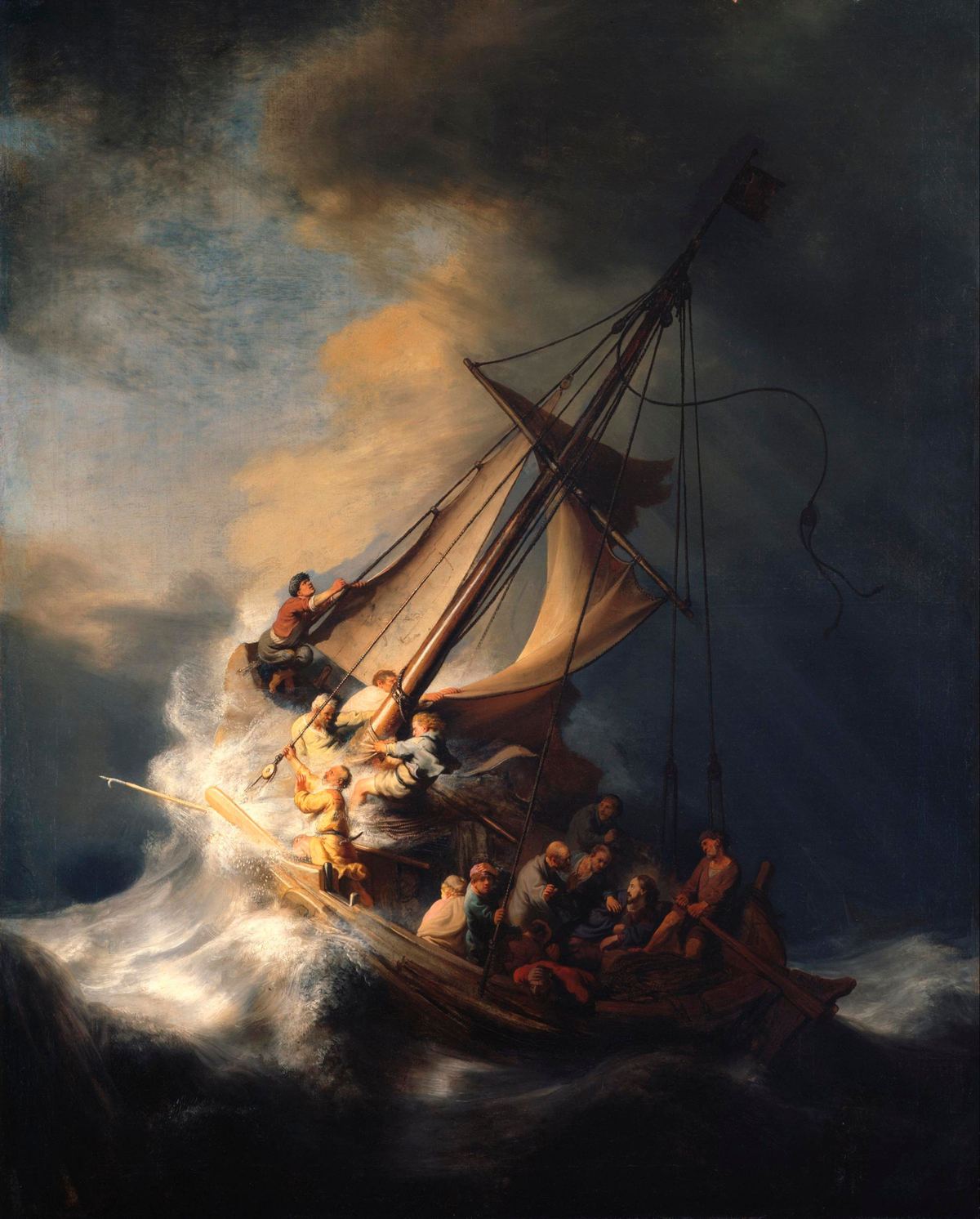
A shipowner was about to send to sea an emigrant ship. He knew that she was old, and not over-well built at the first; that she had seen many seas and climes, and often had needed repairs. Doubts had been suggested to him that possibly she was not seaworthy. These doubts preyed upon his mind, and made him unhappy; he thought that perhaps he ought to have her thoroughly overhauled and refitted, even though this should put him to great expense. Before the ship sailed, however, he succeeded in overcoming these melancholy reflections. He said to himself that she had gone safely through so many voyages and weathered so many storms that it was idle to suppose she would not come safely home from this trip also. He would put his trust in Providence... He watched her departure with a light heart... and he got his insurance-money when she went down in mid-ocean and told no tales.
Clifford asks: what shall we say of him? That he was guilty of the deaths of those men. He sincerely believed the ship was sound, but “he had no right to believe on such evidence as was before him.” He had acquired his belief “not by honestly earning it in patient investigation, but by stifling his doubts.”
Then Clifford changes the story: suppose the ship had been sound after all and made the voyage safely. Would the shipowner be less guilty? “Not one jot. When an action is once done, it is right or wrong for ever; no accidental failure of its good or evil fruits can possibly alter that.” The shipowner “would not have been innocent, he would only have been not found out.” The wrong lay in how he formed his belief.
Clifford’s conclusion: “It is wrong always, everywhere, and for anyone, to believe anything upon insufficient evidence.”
His reasons go beyond the shipowner’s case:
- Beliefs guide action, and no belief is so trivial that it might not someday affect how we act.
- Beliefs are social. “No one man’s belief is in any case a private matter which concerns himself alone.” Our beliefs are passed on to others and become part of the common stock by which a society lives.
- Credulity is contagious and corrosive. “The danger to society is not merely that it should believe wrong things, though that is great enough; but that it should become credulous, and lose the habit of testing things and inquiring into them; for then it must sink back into savagery.”
James’s reply
William James answered Clifford in “The Will to Believe” (1896). He began with some distinctions. A choice between two hypotheses is an option, and options can be:
- Live or dead: a live option is one where both hypotheses are real possibilities for you. (“Be a theosophist or be a Muslim” was a dead option for most of James’s audience.)
- Forced or avoidable: a forced option is one where there is no third alternative. (“Either accept this truth or go without it.”)
- Momentous or trivial: a momentous option is unique, has high stakes, and cannot be reversed.
An option that is live, forced, and momentous is a genuine option. James’s thesis:
“Our passional nature not only lawfully may, but must, decide an option between propositions, whenever it is a genuine option that cannot by its nature be decided on intellectual grounds; for to say, under such circumstances, ‘Do not decide, but leave the question open,’ is itself a passional decision—just like deciding yes or no—and is attended with the same risk of losing the truth.”
James’s key argument turns on the two commandments we met in Chapter 1: “Believe truth!” and “Shun error!” Clifford, James says, cares only about avoiding error, preferring to risk losing the truth rather than risk believing a falsehood. That preference is itself a choice of temperament, not a requirement of logic. “A rule of thinking which would absolutely prevent me from acknowledging certain kinds of truth if those kinds of truth were really there, would be an irrational rule.”
James also points to cases where faith in a fact can help create the fact. Whether someone likes you may depend partly on whether you believe they do and act accordingly. A train can be held up by a few robbers because each passenger, though brave, doubts that the others will support him if he resists; if each believed the others would act, the robbery would fail. In such cases, refusing to believe until the evidence is in guarantees that the evidence will never come.
Assessing the debate
In Clifford’s favor:
- His shipowner example is compelling, and it applies directly to situations of power and responsibility: public officials, doctors, engineers, and anyone whose beliefs affect others.
- James’s thesis, stated loosely, seems to license wishful thinking, which is exactly the vice Clifford identified.
In James’s favor:
- Clifford’s principle is very demanding. Hardly anyone could live by it, and it is not obvious that there is “sufficient evidence” for the principle itself.
- James’s conditions are strict: the option must be genuine and impossible to decide on intellectual grounds. He is not defending belief against the evidence, only belief where evidence cannot settle the matter.
- In cases where belief helps create the fact, withholding belief is not neutral.
A reconciliation. Look closely at Clifford’s shipowner, and you will see that his fault lies as much in his inquiry as in his belief: he had reason to doubt, and he chose not to investigate. Much of what Clifford condemns is negligent inquiry and stifling doubt, which James never defended. On this reading, the ethics of belief is largely an ethics of inquiry: of gathering evidence, facing doubts, and consulting others, especially when others depend on your beliefs. This also answers the worry that we cannot choose our beliefs directly (see Deontology and doxastic voluntarism): we can choose how we inquire.
Peter van Inwagen (“It Is Wrong, Everywhere, Always, and for Anyone, to Believe Anything upon Insufficient Evidence,” 1996) turned Clifford’s principle on philosophers. Philosophers hold confident views on questions where their equally able colleagues disagree. If Clifford is right, most philosophical (and political) belief is wrong. If it isn’t wrong, then Clifford’s principle must be too strong, or evidence must be subtler than it seems. The problem connects to peer disagreement.
Practical reasons for belief
As noted in Chapter 1, there is a difference between reasons that bear on whether a belief is true and reasons that bear on whether it is good to have. Can the latter ever justify belief?
Pascal’s Wager. Blaise Pascal (Pensées, published 1670) argued that reason cannot settle whether God exists, so we must wager. If you believe and God exists, you gain infinite happiness; if you believe and God doesn’t exist, you lose little. If you don’t believe and God exists, you may lose infinitely. So the rational bet is to believe. Pascal knew we can’t believe at will, and advised the unbeliever to act as if they believed (“taking the holy water, having Masses said”) so that belief would follow.
Objections.
- The many-gods objection: many possible gods, with different requirements, could reward or punish belief. The wager doesn’t tell you which to bet on.
- Infinite utilities cause mathematical trouble: any nonzero probability of infinite reward swamps every other consideration. A modern parody is “Pascal’s mugging” (Eliezer Yudkowsky, 2007; developed by Nick Bostrom, 2009): a stranger promises you an astronomically large reward if you hand over your wallet. The probability that he is telling the truth is tiny, but if the promised reward is large enough, expected-value reasoning says you should pay. Most people conclude that something has gone wrong with naive expected-value reasoning when tiny probabilities meet enormous payoffs.
- Would God reward self-interested belief? Many religious traditions value sincere faith, not calculated bets.
Beneficial beliefs. Some beliefs seem to have practical benefits whatever their truth. Shelley Taylor and Jonathon Brown (“Illusion and Well-Being,” 1988) argued that mildly optimistic “positive illusions” about oneself, one’s control, and one’s future are associated with mental health. This view has been contested, and the related claim of depressive realism (that mildly depressed people judge their control more accurately; Lauren Alloy and Lyn Abramson, 1979) turned out to be a small and inconsistent effect in later meta-analyses. Placebo effects show that expectations can affect outcomes. None of this settles whether we should hold beliefs for their benefits. Most epistemologists argue that practical benefits are “the wrong kind of reason” for belief itself, though they may be good reasons for actions (such as seeking optimistic friends or taking a placebo) that happen to change our beliefs.
Virtue epistemology
Virtue epistemology shifts attention from beliefs to the knower: from “What makes a belief justified?” to “What makes someone a good thinker?” It models itself on Aristotle’s virtue ethics, which asks not “What rules should I follow?” but “What kind of person should I be?”
Reliabilist virtue epistemology
Ernest Sosa introduced the term “intellectual virtue” into contemporary epistemology in “The Raft and the Pyramid” (1980). For virtue reliabilists (Sosa, Knowledge in Perspective, 1991; John Greco, Achieving Knowledge, 2010), intellectual virtues are reliable cognitive faculties or abilities: good eyesight, accurate memory, sound reasoning, skill at recognizing faces. Knowledge is true belief that results from the exercise of such abilities (see Virtue-theoretic accounts).
Responsibilist virtue epistemology
Virtue responsibilists (Lorraine Code, Epistemic Responsibility, 1987; James Montmarquet, Epistemic Virtue and Doxastic Responsibility, 1993; Linda Zagzebski, Virtues of the Mind, 1996; Robert Roberts and Jay Wood, Intellectual Virtues, 2007; Jason Baehr, The Inquiring Mind, 2011) understand intellectual virtues as character traits like open-mindedness, intellectual courage, and intellectual humility. These traits involve motivation, a love of truth or knowledge, as well as the skill to act on it.
Zagzebski defines a virtue as “a deep and enduring acquired excellence of a person, involving a characteristic motivation to produce a certain desired end and reliable success in bringing about that end.” Intellectual virtues are those whose motivational component is a desire for “cognitive contact with reality.”
Roberts and Wood call their approach regulative epistemology, a term from Nicholas Wolterstorff’s work on Locke: its aim is not to define knowledge but to guide people in forming beliefs and conducting inquiry well. The practical chapters of this guide are regulative epistemology.
The situationist challenge. Social psychologists have found that behavior often depends more on the situation than on stable character traits. Mark Alfano (“Expanding the Situationist Challenge to Responsibilist Virtue Epistemology,” 2012) argued that the same applies to intellectual behavior: whether people reason carefully depends heavily on mood, framing, time pressure, and incentives. If so, robust intellectual virtues may be rare. Virtue epistemologists reply that virtues are ideals to aim at, that they can be cultivated, and that part of wisdom is designing situations (such as checklists, peer review, and cooling-off periods) that support good reasoning.
A catalogue of intellectual virtues
Following Aristotle, each virtue can be seen as a mean between two vices: one of deficiency and one of excess. Jason Baehr (Cultivating Good Minds, 2015) identifies nine “master” intellectual virtues, used here with additions.
| Virtue | What it involves | Vice of deficiency | Vice of excess |
|---|---|---|---|
| Curiosity | A disposition to wonder, ask why, and seek understanding | Apathy, incuriosity | Idle or prying curiosity; distraction |
| Intellectual humility | Being attentive to, and owning, your intellectual limitations and mistakes | Arrogance, vanity | Servility, self-deprecation, timidity |
| Intellectual autonomy | Thinking for yourself; not simply deferring | Gullibility, intellectual servility | Refusing all trust; “epistemic egoism” |
| Attentiveness | Being present to and noticing what matters | Inattention, distraction | Hypervigilance |
| Intellectual carefulness | Avoiding errors; checking | Carelessness, hastiness | Perfectionism, paralysis |
| Intellectual thoroughness | Seeking deep and full explanations | Superficiality | Pedantry |
| Open-mindedness | Willingness and ability to take alternative views seriously | Closed-mindedness, dogmatism | Credulity; indecision; “so open your brain falls out” |
| Intellectual courage | Pursuing and defending the truth despite fear of social or personal costs | Cowardice, conformity | Recklessness, reflexive contrarianism |
| Intellectual tenacity | Persisting in inquiry and belief despite difficulty | Giving up too easily | Stubbornness, dogmatism |
Other important virtues:
- Intellectual honesty: not deceiving yourself or others; acknowledging evidence against your view; giving credit to others.
- Fair-mindedness: applying the same standards to views you like and views you dislike.
- Intellectual charity (generosity): interpreting others in the best light (see The principle of charity).
- Intellectual empathy: the ability to imagine yourself in another’s position and understand their reasoning from the inside.
- Love of truth: caring about getting things right, beyond winning arguments or feeling comfortable.
- Practical wisdom (phronēsis): knowing which virtue a situation calls for. Should you stay tenacious or be open to changing your mind? Should you trust this source or think for yourself? No rule settles this; judgment does.
(The educators Richard Paul and Linda Elder, whose work shaped much critical-thinking teaching, list a similar set of “intellectual traits”: humility, courage, empathy, autonomy, integrity, perseverance, confidence in reason, and fair-mindedness.)
Virtues in action
Ibn al-Haytham’s self-suspicion. The investigator of truth, wrote Ibn al-Haytham (see Chapter 2), “should also suspect himself as he performs his critical examination of it, so that he may avoid falling into either prejudice or leniency.” This is humility and fair-mindedness together.
Darwin’s golden rule. In his Autobiography, Charles Darwin described a habit that is a perfect example of intellectual honesty put into practice:
“I had, also, during many years followed a golden rule, namely, that whenever a published fact, a new observation or thought came across me, which was opposed to my general results, to make a memorandum of it without fail and at once; for I had found by experience that such facts and thoughts were far more apt to escape from the memory than favourable ones.”
Darwin had noticed his own confirmation bias and devised a simple procedure to counteract it. That is what an intellectual virtue looks like in practice: not a feeling but a habit.
Intellectual courage. Semmelweis defending handwashing against his profession (see Inference to the best explanation); the single dissenter in Asch’s experiment (see Conformity); a junior colleague who points out an error in the boss’s analysis. Courage is required whenever truth is socially costly.
Intellectual vices
Quassim Cassam (Vices of the Mind, 2019) develops a theory of epistemic vices: character traits, attitudes, or ways of thinking that systematically obstruct the acquisition, keeping, or sharing of knowledge (he calls his view obstructivism). He distinguishes:
- Character vices: stable traits such as closed-mindedness, gullibility, dogmatism, and intellectual cowardice.
- Attitude vices: attitudes such as epistemic insouciance (a casual indifference to truth and evidence, close to Frankfurt’s notion of bullshit) and intellectual arrogance.
- Thinking vices: ways of thinking such as wishful thinking, closed-minded thinking, and jumping to conclusions.
Cassam’s example is “Oliver,” who believes the 9/11 attacks were an inside job. Oliver has seen the evidence that al-Qaeda was responsible; he has encountered the engineering explanations of the towers’ collapse. Why does he still believe the conspiracy theory? Cassam argues that the best explanation is not a lack of information but features of Oliver’s intellectual character: gullibility toward conspiracy websites, carelessness in evaluating sources, and closed-mindedness toward the alternatives.
Cassam also notes that many vices are stealthy (“Stealthy Vices,” 2015): they are hard to detect in yourself because of what they are. A closed-minded person is closed to the suggestion that they are closed-minded; an arrogant person is too arrogant to notice their arrogance. This is one reason why feedback from others, and structured practices like Darwin’s, are so valuable.
Other vices worth naming:
- Intellectual laziness: failing to put in the effort that a question requires.
- Dogmatism: treating one’s views as beyond question.
- Prejudice: prejudging people or claims on irrelevant grounds (see Epistemic injustice).
- Negligence: failing to inquire when one should (Clifford’s shipowner).
- Epistemic cowardice: failing to say what one believes, or to look into things one fears the answer to.
- Contrarianism: rejecting views because they are widely held.
- Motivated credulity and motivated skepticism: believing easily what one wants to believe and doubting what one doesn’t (see Chapter 14).
Epistemic humility and confidence
Intellectual humility is perhaps the most discussed intellectual virtue today. Dennis Whitcomb, Heather Battaly, Jason Baehr, and Daniel Howard-Snyder (“Intellectual Humility: Owning Our Limitations,” 2017) define it as being appropriately attentive to, and owning, one’s intellectual limitations: gaps in knowledge, cognitive mistakes, biases, and deficits in skill. Owning a limitation means acknowledging it, caring about it, and being disposed to respond appropriately (for example, by seeking help, deferring, or lowering confidence).
Humility is not the same as low confidence. The goal is accurate confidence: knowing what you know and what you don’t. (Recall Confucius: “When you know something, to hold that you know it; when you do not know something, to allow that you do not know it: this is knowledge.”) An intellectually humble expert may be highly confident within her domain and quick to say “I don’t know” outside it.
Two errors must be avoided:
- Overconfidence and arrogance: claiming more knowledge than you have, dismissing others, and failing to learn. This is the more common error (see Overconfidence). Darwin observed in The Descent of Man (1871) that “ignorance more frequently begets confidence than does knowledge.”
- Underconfidence and servility: failing to trust your own well-founded judgment, deferring to others who know less, or being so paralyzed by the possibility of error that you contribute nothing. Alessandra Tanesini and others argue that intellectual servility can be a vice, especially among people who have been taught not to trust themselves. W. B. Yeats’s lines from “The Second Coming” (1920) describe what happens when this vice spreads among the best people: “The best lack all conviction, while the worst / Are full of passionate intensity.”
Research on intellectual humility is young, but studies (for example, by Mark Leary and colleagues, 2017, and Tenelle Porter and Karina Schumann, 2018) have found that people who score higher on measures of intellectual humility are more willing to consider opposing viewpoints and to evaluate the strength of evidence accurately. See also Calibration and scoring rules, which gives a precise meaning to “accurate confidence.”
Open-mindedness and its limits
Jason Baehr defines open-mindedness as being “willing and (within limits) able to transcend a default cognitive standpoint in order to take up or take seriously the merits of a distinct cognitive standpoint.”
Open-mindedness is not:
- Having no opinions.
- Treating all views as equally plausible.
- Being unable to reach conclusions.
- Refusing to call anything false.
G. K. Chesterton put the point memorably: “The object of opening the mind, as of opening the mouth, is to shut it again on something solid” (Autobiography, 1936).
Must we engage with every argument?
Jeremy Fantl (The Limitations of the Open Mind, 2018) asks whether we are obliged to be open-minded toward every argument against what we believe. His answer is no. Sometimes you can know that an argument is misleading, that its conclusion is false, even if you cannot immediately find the flaw. You have seen clever “proofs” that 1 = 2 (they divide by zero somewhere). You have heard Zeno’s paradoxes “proving” that motion is impossible (Achilles can never overtake the tortoise, because each time he reaches where it was, it has moved on). It was rational to believe in motion long before mathematicians developed the theory of convergent infinite series that explains the flaw. Fantl argues that in such cases you need not change your mind, and need not even be willing to, while still perhaps acknowledging that you cannot rebut the argument.
This point has two edges. It is legitimate: we cannot re-examine every settled belief whenever someone presents an argument we cannot instantly refute (compare Brandolini’s law). But it is dangerous: everyone who wants to avoid uncomfortable arguments will say that their case is like Zeno’s. The difference lies in how strong your independent evidence for the conclusion is. Evidence for the existence of motion is overwhelming; evidence for most contested political views is not.
False balance
In journalism, treating two positions as equally credible when the evidence overwhelmingly supports one is called false balance. Maxwell and Jules Boykoff (“Balance as Bias,” 2004) found that in the prestige US press between 1988 and 2002, a majority of articles on climate change gave roughly equal attention to the scientific consensus and to the views of a small group of skeptics, conveying a misleading picture of the state of scientific knowledge. Open-mindedness toward every view does not require presenting every view as equally supported.
Pragmatic encroachment
Should the practical stakes of a belief affect whether you know it, or are justified in holding it?
Recall DeRose’s bank cases (Contextualism). With the same evidence (the bank was open two Saturdays ago), it seems you know the bank will be open tomorrow if little is at stake, but not if a large bill will bounce. Jason Stanley (Knowledge and Practical Interests, 2005), John Hawthorne (Knowledge and Lotteries, 2004), and Jeremy Fantl and Matthew McGrath (Knowledge in an Uncertain World, 2009) defend pragmatic encroachment: whether a subject knows p (or is justified in believing p) depends partly on the subject’s practical situation.
Their central principle links knowledge and action: if you know p, then it is rational for you to act as if p (Fantl and McGrath’s formulation). If the stakes are high enough that it isn’t rational to act as if p (you should check with the bank first), then you don’t know p.
Objections.
- Shifting knowledge. Pragmatic encroachment implies that knowledge can come and go as stakes change, without any change in evidence. “I knew the bank would be open until you told me about the bill” sounds odd.
- Knowledge across people. Two people with the same evidence could differ in whether they know, just because one has more at stake. “She knows the bank will be open, but I don’t, though we have exactly the same evidence” sounds strange.
- Alternative explanations. Perhaps stakes affect not knowledge but belief or confidence (Jennifer Nagel, 2008, argues that high stakes make people less confident and more inclined to seek further evidence), or perhaps they affect only whether it is rational to act without further inquiry, which is a question of practical, not epistemic, rationality.
The practical upshot is uncontroversial, whichever theory is right: when the cost of being wrong is high, gather more evidence before acting. “Measure twice, cut once.” This principle underlies the different standards of proof in criminal and civil law, the argument from inductive risk, and the high evidential bar for approving new medicines.
Moral encroachment
A more controversial idea is moral encroachment: that moral considerations can affect what we are justified in believing, particularly beliefs about individual people.
A case discussed by Tamar Gendler (2011) and Rima Basu (2019): the African American historian John Hope Franklin, a member of the Cosmos Club in Washington, D.C., hosted a dinner there in 1995, on the eve of receiving the Presidential Medal of Freedom. A white woman at the club handed him her coat check and asked him to fetch her coat, assuming he was an attendant. Suppose, as may have been true, that most of the Black people at the club that evening were staff. Did her belief, based on a statistical generalization, wrong Franklin? Many people think it did, even if it was statistically “supported.”
Philosophers such as Rima Basu and Mark Schroeder (“Doxastic Wronging,” 2019), Sarah Moss (Probabilistic Knowledge, 2018), and Renée Jorgensen Bolinger (“The Rational Impermissibility of Accepting (Some) Racial Generalizations,” 2020) argue that:
- Beliefs themselves can wrong people, not only actions.
- When a belief about a person carries a risk of moral harm (such as demeaning them on the basis of race), the evidential threshold for justified belief rises. A statistical generalization may be enough to justify believing that someone in a room is staff, but not to justify believing that this person is.
Critics reply that evidence is evidence: moral considerations should govern our actions and our attention, not what we believe on the evidence. Otherwise, morality would require us to believe against our evidence.
For critical thinking, the debate highlights a point that holds on any view. Base rates about groups are weak evidence about individuals when individuating evidence is available or easily obtained. The woman had not looked for any individuating evidence, though a moment’s inquiry would have revealed that Franklin was the host of the event. Applying a group generalization to an individual, without checking readily available facts about that individual, is often a reasoning failure as well as a moral one. See also The reference class problem.
Faith, reason, and religious epistemology
Religious belief is where the questions of this chapter, and of much of this guide, become most pressing for many people. What follows is a survey of the main positions, not an argument for any of them. Whatever your own view, religious epistemology is an excellent testing ground for general questions about basic beliefs, testimony, experience, disagreement, and falsifiability.
The evidentialist challenge
The evidentialist objection to religious belief (in the spirit of Clifford) holds that belief in God is justified only if it is supported by sufficient evidence or argument, and that it isn’t. Bertrand Russell’s teapot (“Is There a God?,” written 1952) makes the point about the burden of proof: if I claimed that a china teapot orbits the Sun between the Earth and Mars, too small to be detected by telescopes, no one could disprove me, but it would be absurd to demand that others believe it. Antony Flew (“The Presumption of Atheism,” 1972) argued that the burden of proof lies on the theist. See Burden of proof.
Natural theology and its critics
Natural theology attempts to support religious belief by reason and evidence available to anyone. The main arguments:
- Cosmological arguments: the existence of the universe, or of contingent things, requires a first cause or necessary being. Versions appear in Aristotle, Ibn Sīnā, al-Ghazālī (the kalām argument, from the beginning of the universe in time), and Thomas Aquinas’s “Five Ways.”
- Teleological (design) arguments: the order and apparent purpose in nature point to a designer. William Paley’s Natural Theology (1802) compared the eye to a watch found on a heath: its intricacy implies a maker. Modern versions appeal to the fine-tuning of physical constants for life.
- The ontological argument (Anselm, Proslogion, 1078): God is “that than which nothing greater can be conceived”; a being that exists in reality is greater than one that exists only in the understanding; so God must exist in reality.
- Moral arguments: objective moral facts require a divine source.
- Arguments from religious experience and from miracles.
Critics include David Hume, whose Dialogues Concerning Natural Religion (1779) argued that the design argument relies on a weak analogy and cannot establish a perfect, infinite designer, and whose “Of Miracles” argued against belief in miracles on testimony; Immanuel Kant, who argued that the ontological argument treats existence as a property (“being is obviously not a real predicate”); and Charles Darwin, whose theory of natural selection provided a non-design explanation of adaptation. The problem of evil is the main argument on the other side: J. L. Mackie (“Evil and Omnipotence,” 1955) argued that the existence of evil is logically inconsistent with an all-powerful, all-good God; William Rowe (“The Problem of Evil and Some Varieties of Atheism,” 1979) argued that the amount of apparently pointless suffering is strong evidence against such a God. Each argument has sophisticated defenders and critics, and the debate continues.
Reformed epistemology
Reformed epistemology (Alvin Plantinga, “Reason and Belief in God,” 1983, and Warranted Christian Belief, 2000; Nicholas Wolterstorff; William Alston) rejects the evidentialist demand. Its argument:
- The evidentialist objection assumes classical foundationalism: a belief is justified only if it is self-evident, incorrigible, or evident to the senses, or inferred from such beliefs.
- Classical foundationalism is self-refuting (see Objections to foundationalism) and would also rule out beliefs we are clearly entitled to, such as belief in other minds and in the past.
- Many rational beliefs are properly basic: justified without being based on arguments.
- Belief in God can also be properly basic, formed directly in response to experiences such as seeing the grandeur of the mountains, feeling guilt, or reading scripture. (Plantinga draws on John Calvin’s idea of a sensus divinitatis, a natural sense of the divine.)
Plantinga later added an argument about the relation between the rationality and truth of religious belief. If God exists, it is likely that God would have designed humans with faculties for knowing about him, in which case belief in God would be warranted. If God does not exist, it probably isn’t. So, Plantinga argues, the question of whether belief in God is warranted cannot be settled independently of whether God exists.
Objection: the Great Pumpkin. Plantinga himself considered the objection: couldn’t anyone claim that any belief is properly basic? Could Linus, in the Peanuts comic strip, claim that belief in the Great Pumpkin is properly basic? Plantinga replied that criteria for proper basicality must be developed by looking at examples, and a community is entitled to start from its own examples. Critics (Michael Martin, Keith DeRose) pressed a stronger version, the “Son of Great Pumpkin” objection: Plantinga’s reasoning would allow any community, with any belief system, to declare its core beliefs properly basic and immune to the evidentialist challenge.
Religious experience
William James’s The Varieties of Religious Experience (1902) studied mystical experience in many traditions. He concluded that mystical states “are absolutely authoritative over the individuals to whom they come,” but that “no authority emanates from them which should make it a duty for those who stand outside of them to accept their revelations uncritically.” That distinction, between the experiencer’s justification and a third party’s reasons, is useful for any unusual experience.
William Alston (Perceiving God, 1991) argued that religious experience can be a form of perception of God, and that Christian mystical practice is a socially established doxastic practice with the same kind of prima facie standing as sense perception: we cannot justify sense perception without circularity either (compare Reid’s parity argument). Richard Swinburne (The Existence of God, 1979) appealed to a principle of credulity: if it seems to someone that something is present, then probably it is, absent special reasons for doubt.
Objections.
- Religious diversity: people in different traditions have experiences that seem to support incompatible beliefs.
- Lack of cross-checks: sense perception is checked against other senses and other observers in systematic ways; religious experience is harder to check.
- Naturalistic explanations: psychological and neurological accounts might explain religious experiences without their objects existing. (Believers reply that God could work through natural processes.)
Falsification and religious language
In a short, famous paper, “Theology and Falsification” (1950), Antony Flew adapted a parable from John Wisdom’s essay “Gods” (1944). In abridged form:
Two explorers come upon a clearing in the jungle. In the clearing are growing many flowers and many weeds. One explorer says, “Some gardener must tend this plot.” The other disagrees. They pitch their tents and set a watch. No gardener is ever seen. “But perhaps he is an invisible gardener.” So they set up a barbed-wire fence, electrify it, and patrol with bloodhounds. No shrieks suggest that an intruder has received a shock; no movements of the wire betray an invisible climber; the bloodhounds never give cry. Yet still the Believer is not convinced. “But there is a gardener, invisible, intangible, insensible to electric shocks, a gardener who has no scent and makes no sound.” At last the Skeptic despairs: “But what remains of your original assertion? Just how does what you call an invisible, intangible, eternally elusive gardener differ from an imaginary gardener or even from no gardener at all?”
Flew argued that religious claims often “die the death of a thousand qualifications”: each time evidence counts against them, they are qualified to avoid refutation, until they assert nothing at all. This is Popper’s falsifiability criterion applied to religious language (see Popper and falsificationism).
Two replies from the same symposium are instructive:
- R. M. Hare agreed that religious beliefs are not falsifiable, but argued they are “bliks”: fundamental attitudes or frameworks for interpreting the world, not hypotheses. His example is a paranoid student convinced that all the dons want to murder him, whom no evidence of kindness can dissuade. Everyone has some blik (for example, confidence that the world is orderly), and the question is whether one’s blik is sane or insane. This anticipates Wittgenstein’s hinges.
- Basil Mitchell told a parable of a resistance fighter who meets a Stranger claiming to be the leader of the resistance. Afterward, the Stranger is sometimes seen helping the resistance and sometimes apparently working with the enemy. The partisan keeps faith, but he admits that the Stranger’s conduct counts against his belief. It is a real trial of faith. Mitchell argued that religious believers can accept that evidence (such as suffering) counts against their beliefs, without abandoning them, as we keep trust in a friend despite some evidence against them. Faith is then like trust in a person, not like a scientific hypothesis.
Fideism
Fideism holds that religious belief does not need, and perhaps should not seek, rational justification. Søren Kierkegaard (Concluding Unscientific Postscript, 1846) argued that faith is a passionate, personal commitment, a “leap,” that objective reasoning can never reach and would only destroy; “truth is subjectivity.” Wittgensteinian fideism (a label coined critically by Kai Nielsen, 1967) holds that religious discourse is a distinct “language game” with its own criteria of meaning and justification, which outsiders misunderstand when they treat religious claims as empirical hypotheses. Wittgenstein remarked in his Lectures on Religious Belief that a believer who says “There will be a Last Judgment” and a non-believer who denies it are not contradicting each other in the way two people disagreeing about a scientific prediction do.
The main objection to fideism is that it insulates beliefs from criticism, and that the same insulation is available to any belief system whatever, including dangerous ones.
Religious disagreement
Intelligent, sincere, informed people hold very different religious views. Richard Feldman (“Reasonable Religious Disagreements,” 2007) applied the peer disagreement debate to religion and argued that, once people have shared their evidence, suspension of judgment may be the reasonable response. John Hick (An Interpretation of Religion, 1989) proposed religious pluralism: the great religious traditions are different culturally shaped responses to a single ultimate reality. Critics reply that this reinterprets each tradition in a way most of its adherents would reject.
A useful discipline for everyone, religious or not, is the symmetry test: apply to your own tradition’s claims the same standards you apply to the claims of other traditions (and to non-religious worldviews, including your own).
Check your understanding
1Why does Clifford say the shipowner is guilty even if the ship arrives safely?
Answer
Because the wrong lay in how he formed his belief (stifling his doubts rather than investigating), not in its consequences. Luck in the outcome doesn’t change the wrongness of the process: “he would not have been innocent, he would only have been not found out.”
2State James’s conditions for a “genuine option.” Give an example of a genuine option and of one that isn’t.
Answer
Live (both options are real possibilities for you), forced (no third alternative), and momentous (unique, high stakes, irreversible). For James, and for many people, the choice whether to have religious faith. Not genuine: whether to believe that a particular stock will rise (avoidable, since you can suspend judgment and not invest, and not momentous for most).
3Distinguish reliabilist and responsibilist virtue epistemology.
Answer
Reliabilists take intellectual virtues to be reliable cognitive faculties (good vision, memory, reasoning). Responsibilists take them to be character traits (open-mindedness, intellectual courage, humility) involving motivation to know as well as skill.
4Give the vices of deficiency and excess for intellectual tenacity and for open-mindedness.
Answer
Tenacity: giving up too easily (deficiency), stubbornness or dogmatism (excess). Open-mindedness: closed-mindedness (deficiency), credulity or indecision (excess).
5What is a “stealthy” vice, and what follows for how we should guard against vices?
Answer
A vice that tends to hide itself from the person who has it, because it impairs the very capacities needed to detect it (closed-mindedness closes one to evidence of closed-mindedness). So we can’t rely on introspection to catch our own vices; we need external checks: feedback from others, structured habits (like Darwin’s golden rule), and institutions that expose our reasoning to criticism.
6Is it closed-minded to refuse to change your mind in response to an argument you can’t refute?
Answer
Not necessarily. If you have overwhelming independent evidence that the conclusion is false (as with Zeno’s arguments against motion), you can reasonably conclude that the argument has a flaw you haven’t found. But this is only reasonable when your independent evidence really is overwhelming. Using the same move to protect weakly supported beliefs is closed-mindedness.
7Explain Flew’s gardener parable and one reply to it.
Answer
The believer’s claim about a gardener is qualified each time evidence fails to support it, until it becomes indistinguishable from the claim that there is no gardener. Flew concluded that such claims “die the death of a thousand qualifications.” Replies: Hare’s “bliks” (religious beliefs are interpretive frameworks, not hypotheses); Mitchell’s partisan (evidence can count against a belief held on trust, without the believer abandoning it, as with trust in a person).
8What practical principle follows from the pragmatic encroachment debate, whichever side is right?
Answer
When the cost of error is high, gather more evidence and be more cautious before acting. The debate is about whether this is a fact about knowledge itself or about practical rationality, but the practical advice is the same.
Further reading
The ethics of belief
- W. K. Clifford, “The Ethics of Belief” (1877), and William James, “The Will to Believe” (1896). Both short, both freely available online; read them together.
- Andrew Chignell, “The Ethics of Belief,” Stanford Encyclopedia of Philosophy.
- Peter van Inwagen, “It Is Wrong, Everywhere, Always, and for Anyone, to Believe Anything upon Insufficient Evidence” (1996).
Virtue epistemology
- Linda Zagzebski, Virtues of the Mind (Cambridge University Press, 1996).
- Robert Roberts and W. Jay Wood, Intellectual Virtues: An Essay in Regulative Epistemology (Oxford University Press, 2007). Rich on the individual virtues.
- Jason Baehr, The Inquiring Mind (Oxford University Press, 2011) and (ed.) Intellectual Virtues and Education (Routledge, 2016).
- Heather Battaly, Virtue (Polity, 2015).
- Quassim Cassam, Vices of the Mind: From the Intellectual to the Political (Oxford University Press, 2019).
- Ian James Kidd, Heather Battaly, and Quassim Cassam (eds.), Vice Epistemology (Routledge, 2020).
Humility and open-mindedness
- Jeremy Fantl, The Limitations of the Open Mind (Oxford University Press, 2018).
- Alessandra Tanesini, The Mismeasure of the Self: A Study in Vice Epistemology (Oxford University Press, 2021).
Encroachment
- Jason Stanley, Knowledge and Practical Interests (Oxford University Press, 2005).
- Jeremy Fantl and Matthew McGrath, Knowledge in an Uncertain World (Oxford University Press, 2009).
- Rima Basu, “What We Epistemically Owe to Each Other,” Philosophical Studies 176 (2019).
Religious epistemology
- Alvin Plantinga and Nicholas Wolterstorff (eds.), Faith and Rationality: Reason and Belief in God (University of Notre Dame Press, 1983).
- J. L. Mackie, The Miracle of Theism (Oxford University Press, 1982). The classic critical assessment.
- Alvin Plantinga, Knowledge and Christian Belief (Eerdmans, 2015). A shorter version of Warranted Christian Belief.
- William Alston, Perceiving God (Cornell University Press, 1991).
- Antony Flew, R. M. Hare, and Basil Mitchell, “Theology and Falsification,” in Flew and MacIntyre (eds.), New Essays in Philosophical Theology (SCM Press, 1955).
- Graham Oppy, Arguing about Gods (Cambridge University Press, 2006).
- John Hick, An Interpretation of Religion (Macmillan, 1989; 2nd ed. 2004).
Concepts from this chapter
Each has its own page with the key idea, objections and replies, common mistakes, and a self-check, in English and Persian.